
January Market Update: Steady as She Goes
After the impressive run in 2025, U.S. markets started 2026 much like a long-distance runner catching their breath. Early in the month, the S&P 500 briefly climbed above the 7,000 level before momentum cooled, ultimately finishing January with modest gains. That pause felt healthy after last year’s sprint. Investors responded positively to strong earnings and encouraging economic data early on, but profit-taking and ongoing questions about monetary policy kept enthusiasm in check as the month progressed.
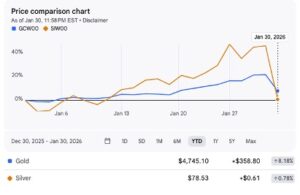
Overseas markets stole some of the spotlight in January, with international stocks advancing more noticeably than U.S. equities. Emerging markets led the way amid a weaker U.S. dollar and improving growth prospects abroad. Commodities told a mixed story. Oil prices rallied toward multi-month highs as the dollar slipped, while precious metals such as gold and silver eased as real yields rose and the perceived need for safe-haven assets diminished.
On the economic front, the data remained encouraging. Third-quarter 2025 GDP was revised higher again, reflecting resilient consumer spending and export strength. Inflation continued its gradual march lower, consumer sentiment improved for a second straight month, and corporate earnings broadly exceeded expectations. Not a bad way to kick off the year.
U.S. Markets: A Lot of Noise, Not Much Movement
January delivered modest gains, but little follow-through. Major U.S. equity benchmarks finished the month higher overall, though day-to-day trading was marked by frequent swings as investors digested earnings reports, shifting interest rate expectations, and political developments tied to Federal Reserve leadership. The S&P 500 gained approximately 1.4% for the month, while the Dow Jones Industrial Average and NASDAQ Composite posted smaller advances.
The more interesting story unfolded beneath the surface. Market leadership continued to expand beyond the handful of mega-cap technology stocks that dominated much of 2025. Cyclical sectors such as Industrials and parts of Consumer Discretionary benefited from the solid economic backdrop, while defensive areas helped anchor the market during brief periods of consolidation. Whether this broadening trend continues will be one of the key questions heading into February.
Major Index Performance: January 2026
| Index | Month Close | Monthly Return |
| S&P 500 | 6,969 | +1.4% |
| Dow Jones Industrial Average | 48,892 | +1.7% |
| NASDAQ Composite | 23,461 | +0.9% |
| Russell 2000 | 2,613 | +5.3% |
| Source: Morningstar |
Global Markets: The Rest of the World Had a Great Month
While U.S. markets posted modest gains, global equities moved more decisively higher. The MSCI World Index gained roughly 2.6% in January, extending momentum from late 2025. Emerging markets stood out with gains approaching 9%, significantly outpacing developed markets.
Europe and Japan contributed meaningfully to global performance, while a weaker U.S. dollar provided a tailwind for dollar-denominated assets abroad. Differences in inflation trends, central bank policies, and earnings growth continued to shape regional performance. The broadening of leadership beyond U.S. stocks that began late last year appears to be gaining traction.
International Equity Performance: January 2026
| Index | January | 3-Month |
| MSCI EAFE | +5.22% | +8.87% |
| MSCI Emerging Markets | +8.86% | +8.70% |
| MSCI World | +2.26% | +3.66% |
| MSCI Europe | +4.46% | +9.39% |
Source: msci.com
Commodities: Oil Up, Gold Down
Commodity markets delivered mixed results in January. Crude oil prices climbed to their highest levels since September, supported by a weaker U.S. dollar that made dollar-priced commodities more attractive to overseas buyers. Demand expectations remained steady, and there were no major supply disruptions during the month.
Gold and silver moved in the opposite direction, giving back some of their recent gains. Rising real yields and shifting expectations around Federal Reserve policy made precious metals less appealing. When bonds offer higher real returns, the opportunity cost of holding non-yielding assets like gold increases, and that dynamic played out clearly in January.
Source: FMeX
The Economy: Still Growing, Still Moderating
The key economic headline was the upward revision to third-quarter GDP growth, now estimated at an annualized 4.4%, the strongest pace since 2023. Stronger exports and fewer inventory headwinds drove the revision, signaling that the economy entered the new year with meaningful momentum.
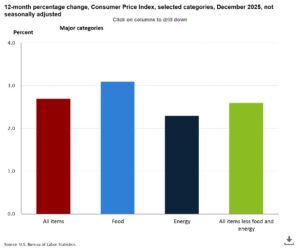
Inflation continued to cool. December’s headline Consumer Price Index came in at 2.7% year over year, while core inflation registered 2.6%, its lowest reading since 2021. Forecasts from the Cleveland Fed suggested January inflation could come in even lower. While inflation has not yet reached the Federal Reserve’s 2% target, the direction of travel remains encouraging.
Corporate Earnings: Companies Keep Delivering
Earnings season remained a bright spot. By late January, roughly three-quarters of S&P 500 companies that had reported results exceeded expectations. That strong beat rate helped support equity prices despite elevated valuations.
Looking ahead, analysts expect earnings growth of roughly 14% for 2026, with stronger momentum anticipated in the first half of the year. Valuations remain stretched, however. The S&P 500’s forward price-to-earnings ratio sits above both five- and ten-year averages. In other words, stocks are not cheap, and companies will need to continue delivering earnings growth to justify current prices.
How Are Consumers Feeling?
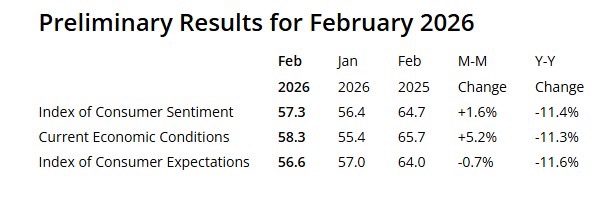
Consumer sentiment improved modestly in January and it expected to further improve in February. The University of Michigan’s Consumer Sentiment Index rose to 56.4 in January, up from 52.9 in December and the highest reading since last August. The improvement was broad-based across income levels, age groups, and political affiliations.
That said, sentiment remains below where it stood a year ago. Consumers are feeling somewhat better, but they are far from carefree. High prices and ongoing economic uncertainty continue to weigh on confidence.
Spending behavior tells a more optimistic story. Holiday sales from November through December grew 4.1% compared to last year, near the upper end of industry forecasts. Total retail sales in December rose 3.5% year over year. Consumers may be cautious, but they are still spending, a pattern that has persisted over the past year.
Source: https://www.sca.isr.umich.edu/
Housing: Still Waiting for a Breakthrough
The housing market continued its familiar pattern of incremental progress mixed with persistent challenges. Mortgage rates eased modestly from recent peaks, bringing some stabilization to activity. However, affordability remains a significant hurdle. Elevated home prices combined with still-high borrowing costs continue to sideline many potential buyers. A more durable recovery has yet to emerge.
Manufacturing: Slowly Getting Back on Its Feet
Manufacturing data offered cautious signs of improvement. The S&P Global Manufacturing PMI rose to 51.9 in January, marking a second consecutive month of expansion. Output reached its strongest pace since August, and new orders rebounded after a December dip.
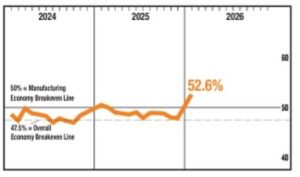
Other indicators painted a more restrained picture. The ISM Manufacturing Index rose to 52.6, compared to the seasonally adjusted reading of 47.9% in December. Manufacturing appears to be stabilizing, but the recovery remains uneven and highly dependent on region and industry.
Source: ISM
Bottom Line
January was a month of consolidation for U.S. markets following the strong gains of 2025, and that pause is not necessarily a negative. Markets rarely move in straight lines, and taking time to digest prior gains is often a healthy part of a longer-term advance.
The fundamental backdrop remains constructive. Economic growth continues, inflation is cooling, corporate earnings are exceeding expectations, and consumers remain active. The broadening of market leadership beyond a small group of stocks is another encouraging sign and reinforces the importance of diversification.
Risks remain. Valuations are elevated, meaning earnings disappointments could be met with sharper market reactions. The path forward for Federal Reserve policy remains uncertain, and political developments surrounding Fed leadership add complexity. Inflation is trending in the right direction, but it has not yet reached the finish line.
For investors, the playbook remains the same. Stay diversified, stay disciplined, and stay focused on long-term goals. The winners of 2025 will not automatically be the winners of 2026, and a steady, patient approach will continue to serve investors well as the year unfolds.
Sources:
Nrf.com | bea.gov | bls.gov | ISM | msci.com | spglobal.com | Morningstar | clevelandfed.org | FMeX | | www.sca.isr.umich.edu