
November Market Update: The Streak Ends
After six straight months of gains, the S&P 500 finally took a breather in November, declining about 0.6%. But don’t let that modest loss fool you – it was a volatile month with a sharp mid-month selloff followed by a strong Thanksgiving week rally that salvaged what could have been a much worse month.
U.S. Markets Hit Some Turbulence
The major indexes showed different patterns in November. The S&P 500 ended its six-month winning streak with a small loss, while the NASDAQ fell nearly 2%, breaking a seven-month run. Meanwhile, the Dow managed to stay roughly flat, extending its monthly winning streak to seven – the longest since 2018.
The real story was what happened under the hood. At one point mid-month, the S&P 500 was down about 5% from its October peak before staging a strong recovery in the final week. All three major indexes rallied on the last trading day, helping to minimize the monthly damage.
November’s Results:
- Dow Jones: roughly flat (≈0%)
- S&P 500: -0.6%
- NASDAQ: -1.9%
- Russell 2000: +0.8%
Small-cap stocks were the bright spot, gaining 0.8% and continuing their multi-month stretch of outperformance. This suggests the market rally is broadening beyond just the mega-cap names.
Leadership Shifted Dramatically
November saw a major rotation out of high-growth technology stocks and into more defensive areas. After leading the market all year, tech stocks lagged as investors questioned AI-related valuations and took profits following the huge run-up.
The winners were sectors that had been left behind earlier in the year: Healthcare jumped 9.1%, becoming the month’s leader. Consumer Staples gained 3.9%, Materials rose 4.0%, and even Utilities added 1.3%. These defensive sectors attracted money as investors looked for stability amid the volatility.
Sector Performance for November
| S&P 500 Sector | November 2025 | Year-to-Date |
| Health Care | +9.14% | +14.26% |
| Communication Services | +6.34% | +33.83% |
| Consumer Staples | +3.94% | +3.34% |
| Materials | +3.97% | +6.29% |
| Real Estate | +1.84% | +2.51% |
| Energy | +1.76% | +4.85% |
| Financials | +1.74% | +10.09% |
| Utilities | +1.33% | +19.02% |
| Industrials | -1.01% | +16.39% |
| Consumer Discretionary | -2.44% | +4.59% |
| Information Technology | -4.36% | +23.67% |
Source: S&P Dow Jones Indices
Despite November’s decline, Information Technology is still up nearly 24% for the year, and Communication Services remains the leader at almost 34% year-to-date. But the rotation suggests investors are getting more cautious about stretched valuations in tech.
Global Markets Also Pulled Back
International markets underperformed U.S. stocks in November, with most major indexes declining. The MSCI EAFE Index (developed markets) fell about 1.4% for the month, though it’s still up an impressive 23.4% year-to-date. Emerging markets dropped 0.9% but remain ahead for the year with gains of 24.8%.
A stronger U.S. dollar created headwinds for international returns when translated back into dollars. Different regions faced their own specific challenges – Europe dealt with weak economic data and ongoing Russia-Ukraine concerns, while China continued to struggle with real estate problems and uneven domestic demand.
The Economy Showed Resilience Despite Data Delays
A government shutdown created data delays that made it harder to get a clear picture of the economy, but available information pointed to continued resilience.
Second-quarter GDP was revised up again to 3.8% from 3.3%, driven by strong consumer spending and a sharp drop in imports after earlier tariff-related buying. The first quarter had contracted by 0.6%, so the Q2 rebound was significant.
Third-quarter growth estimates ranged widely from 1.3% to 3.9%, with most forecasters expecting something around 2.7%. The Atlanta Fed’s real-time model projected 3.9%, but that’s on the optimistic end. Full-year 2025 growth is expected to come in around 1.4-1.7% – slower than 2024 but still positive.
Inflation Continued to Ease Into Year-End
After months of delays due to the government shutdown, the October and November inflation reports finally arrived — and both came in cooler than expected.
- Headline CPI eased to about 2.7% year-over-year, down from 3.0% in September.
- Core CPI moderated to roughly 3.1%, still above the Fed’s 2% target but directionally improving.
- Shelter costs, the stickiest component all year, finally showed clearer signs of deceleration.
- Goods inflation continued to fall, while services inflation remained elevated but stable.
This two-month stretch of cooling data removed some uncertainty heading into the December Fed meeting and contributed to a decline in Treasury yields in early December. Markets viewed the reports as confirmation that inflation is continuing its slow glide lower — though not yet at levels that would justify aggressive rate cuts.
Long-run inflation expectations, while still elevated, also eased modestly, suggesting consumers are beginning to believe the worst of the inflationary surge is behind them.
Corporate Earnings Stayed Strong
Third-quarter earnings were excellent, with 83% of S&P 500 companies beating expectations. Earnings grew 13.4% year-over-year – the fourth straight quarter of double-digit growth and much better than the 7.9% expected at the quarter’s start.
Revenue growth hit 8.4%, the highest since Q3 2022, with 77% of companies exceeding estimates. This marked the 20th consecutive quarter of year-over-year revenue growth.
Sector earnings growth highlights:
- Information Technology: +28%
- Financials: +25%
- Industrials: +20%
- Materials: +17%
- Utilities: +14%
Profit margins remained elevated at 13.1% – potentially the highest since at least 2009. Looking ahead, analysts expect 7.5% earnings growth in Q4 2025, accelerating to 11.8% in Q1 2026 and 12.7% in Q2 2026.
The forward P/E ratio stood near 22.7, above both the 5-year average of 20.0 and the 10-year average of 18.6, suggesting valuations remain stretched despite the strong earnings.
Consumer Confidence Collapsed
This was one of the most concerning developments of the month. Consumer confidence fell to 51.0 – the second-lowest reading on record and down 29% from a year earlier. The Current Conditions Index dropped to 51.1, the lowest level in the survey’s entire history.
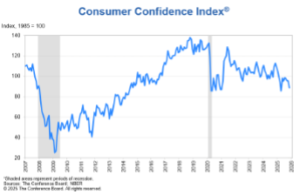
The extended government shutdown, continued high prices, concerns about a softer job market, and market volatility all contributed to the weakness. The big question is whether this terrible sentiment will eventually show up in weaker spending, or whether consumers will keep spending despite feeling pessimistic.
Retail Sales Slowed But Stayed Positive
September retail sales (the latest available) rose just 0.2% month-over-month, down from 0.6% gains in July and August. Core retail sales (excluding autos, gas, and building materials) actually declined 0.1% – the first drop after several months of gains.
Year-over-year, total sales were still up 4.3%, but several categories showed weakness:
- E-commerce: -0.7% for the month (still up 6.0% year-over-year)
- Clothing: -0.7%
- Electronics: -0.5%
- Sporting goods: -2.5%
This suggested consumers were being more selective after strong back-to-school spending, possibly saving up for holiday purchases.
Interestingly, spending patterns varied by income level. The lowest-income households increased spending just 0.6% year-over-year, while the highest-income households increased spending 2.6%. This gap shows how high prices disproportionately hurt lower-income families, while wealthier households with stock market exposure feel better off.
Housing Market Stayed Challenged
Available housing data was limited due to the government shutdown, but the overall picture remained one of affordability challenges. Mortgage rates eased to around 6.19% – the lowest of 2025 – but elevated home prices and economic uncertainty kept many buyers on the sidelines.
The UBS Global Real Estate Bubble Index identified Miami as the U.S. market at highest bubble risk in 2025, followed by other expensive coastal markets. Elevated mortgage rates and low inventory continued to weigh on buyers, especially first-timers and lower-income households.
Manufacturing Stayed Cautious
Regional Fed manufacturing surveys showed continued weakness and caution. Common themes included weak new orders, flat to slightly lower employment, and modest production growth at best. Many business leaders cited uncertainty about tariffs, demand, and the impact of the shutdown on data as reasons for their cautious outlook.
Companies still expected higher costs ahead from tariffs and wages, and many planned to invest in AI while being more careful about traditional manufacturing capacity.
Commodities Told Two Different Stories
The commodity markets showed a sharp split between precious metals and energy:
Gold and silver surged: Gold approached $4,216 per ounce by month-end, up about 7.3% for November and nearly 59% over the prior year. Silver hit record highs with year-to-date gains near 90%. Both benefited from geopolitical risk, inflation concerns, and strong demand from central banks.
Oil prices sank: West Texas Intermediate crude traded below $60 per barrel, and Brent hovered around $76. Oil prices were down about 17% from earlier 2025 highs amid weak Chinese demand and increased supply. Some analysts are projecting Brent could average near $60 in 2026, though such forecasts are uncertain.
The Fed’s Next Move: A December Cut Looks Almost Certain
As of early December, markets are now pricing in a 95%+ probability of another quarter-point rate cut at the Fed’s December 17–18 meeting. The combination of:
- softer October and November inflation,
- moderating wage growth, and
- a cooling labor market
has reinforced expectations for a gradual easing cycle rather than an aggressive one.
Fed officials have signaled comfort with continued economic cooling and appear on track to deliver a December cut that would bring the policy rate into the low-4% range.
Looking ahead to 2026, market futures now imply two to three additional cuts next year — fewer than markets expected earlier in the fall, but consistent with the Fed’s “slow and steady” messaging. The pivot toward holding rates is becoming more likely once the Fed reaches what it views as a neutral or slightly restrictive zone.
Early December Brought a Relief Rally
Markets responded positively to the cooler inflation readings released in early December:
- Treasury yields declined sharply, with the 10-year falling toward 4%.
- Stocks bounced after November’s weakness, led by interest-rate-sensitive sectors.
- Technology stocks recovered modestly after November’s profit-taking.
This bounce helped reinforce the idea that the November pullback was more of a valuation-driven breather than a structural turn in market leadership — though sector rotations may continue as economic data evolves.
Bottom Line
November served as a reminder that even strong markets need to pause. After six months of impressive gains, the pullback — and the sharp rotation away from high-growth technology stocks — reflected growing investor sensitivity to valuations, cooling economic data, and persistent geopolitical uncertainty. The selling pressure mid-month showed how quickly sentiment can shift, but the strong recovery during Thanksgiving week demonstrated just as clearly that investors are still willing to buy dips when the broader economic picture feels stable.
Since then, early December data has helped calm some nerves. Inflation readings for October and November came in cooler than expected, Treasury yields retreated, and equity markets responded with a relief rally. The labor market is cooling gradually, not collapsing, and corporate earnings remain a bright spot with solid growth, healthy margins, and constructive forward guidance. These are not the hallmarks of an economy on the brink — they’re signs of an economy slowly returning to balance.
The Fed now appears poised to deliver another quarter-point cut at its December meeting, reinforcing a shift toward gradual, measured easing rather than aggressive stimulus. For long-term investors, this kind of steady normalization is far more constructive than the sharp, reactive policy swings we’ve seen in the past.
Still, risks remain. Valuations are elevated, consumers remain deeply pessimistic despite continued spending, and sector leadership may continue to shift as markets digest new data. It wouldn’t be surprising to see more volatility — or more rotation — as we close out the year.
But zooming out, the bigger picture remains encouraging: inflation is trending down, growth is slowing but positive, and companies are delivering strong earnings in spite of uncertainty. Historically, December delivers positive returns more often than not, and while nothing is guaranteed, the improving data backdrop gives markets a more solid foundation than they had just a month ago.
At Abaris, our perspective remains the same: short-term volatility is normal, and even healthy. What matters most is staying aligned with your long-term plan — one rooted in your values, vision, and the life you’re building. Markets will ebb and flow, but intentional planning, thoughtful diversification, and a calm, disciplined approach remain the most reliable path to Authentic Wealth.
Sources: bea.gov; bls.gov; census.gov; factset.com; msci.com; spglobal.com; nasdaq.com; wsj.com; sca.isr.umich.edu; conference-board.com